
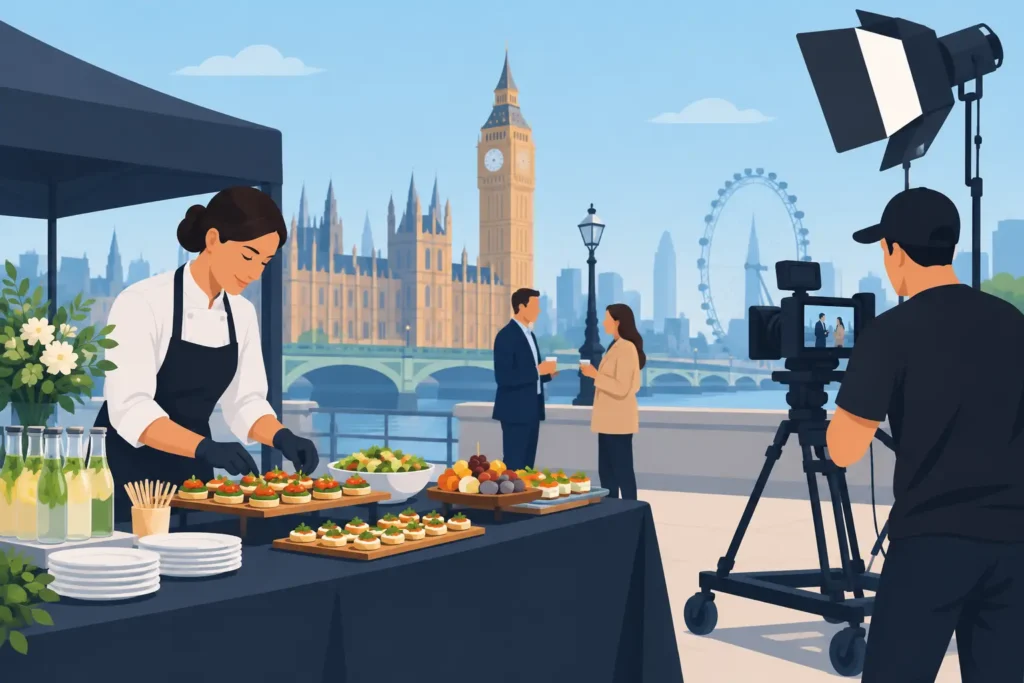
A commercial set can lose time for all sorts of reasons: rain on an exterior, a delayed artist, a lighting reset that runs longer than planned. Lunch should never be one of them. This commercial shoot catering case study shows how a planned food service can keep a 70-person London crew energised when the call sheet, location access and meal breaks are all moving targets.
The scenario is anonymised, but it reflects the challenges our production catering team handles every week. The requirement was simple on paper: serve fresh, satisfying food to cast, crew, agency and client teams across a two-day commercial shoot. In practice, it meant managing an early call time, two locations, staggered breaks, strict dietary needs and a schedule that could change by the minute.
The brief: food that worked around the shoot
The production was filming a lifestyle campaign across a warehouse studio in East London and a nearby exterior location. The main unit had a 06:00 call time. A smaller art department and location team arrived earlier, while agency and client attendees were expected later in the morning. Nobody could stop at the same time.
The line producer needed more than a caterer who could put out a buffet at midday. They needed a team able to coordinate with the assistant director, work safely within a busy unit base, keep tea and coffee flowing, and serve hot food in windows that might move without warning.
The catering plan needed to cover breakfast, hot lunch, afternoon craft service and grab-and-go options for crew members rotating between locations. It also had to accommodate vegetarian, vegan, halal, gluten-free and dairy-free requirements without making anyone feel as though they were receiving a lesser meal.
Budget mattered too. The production wanted generous, creative and flavoursome dishes, but not an overcomplicated menu that required excessive equipment, created unnecessary waste or slowed service.
Commercial shoot catering case study: the plan
Before the first delivery, the catering coordinator reviewed the call sheet, unit base layout, parking restrictions, access times and likely numbers at each service. The headcount was split between main crew, cast, agency, client and runners, with a clear allowance for the inevitable extra pair of hands on a commercial shoot.
Rather than planning one fixed sitting, the team created a service pattern around the production day. Breakfast was available from first call, with hot options replenished for late arrivals. Lunch was prepared for a staggered 45-minute window, allowing departments to come through when released. The exterior unit received insulated hot boxes so the crew could eat proper hot food without returning to base and losing valuable minutes.
The menu was built for energy, speed and broad appeal. Breakfast included hot breakfast baps, plant-based alternatives, fresh fruit, pastries, porridge pots and quality tea and coffee. For lunch, the menu centred on slow-cooked chicken with roasted peppers and herbs, a rich vegetable and chickpea tagine, turmeric rice, seasonal salads, flatbreads and sauces. A separate allergen-controlled selection was labelled and held apart from the main service.
This was not about offering endless choices for the sake of it. A tight menu, cooked well and replenished confidently, is usually a better fit for a production than a sprawling spread that leaves crew queueing or guessing what they can eat.
Why portable service mattered
The exterior team was working several minutes from the main catering point, and their break was likely to be short. Sending them back to unit base would have meant cold food, a late reset or both. Portable hot boxes allowed the catering team to deliver meals directly to the working location at the agreed release time.
That approach required close communication. Food was not dispatched simply because the clock said lunch. The team checked in with production, confirmed that the department was close to breaking, then moved the hot boxes at the right moment. The result was a hot, complete meal where it was needed, not food waiting unnecessarily in a corridor or vehicle.
The challenge: a delayed lunch break
On day one, an exterior scene ran over because the weather changed and lighting had to be adjusted. The original lunch service time moved by 35 minutes. That is exactly the kind of moment that can turn a well-intentioned catering plan into a problem if food has been laid out too early or held without a clear system.
The kitchen team adjusted the holding and finishing schedule, keeping food at safe temperatures while protecting quality. Salads and cold elements remained chilled until the revised service was confirmed. Hot dishes were replenished in smaller batches rather than all placed out at once. Craft catering was brought forward, with fruit, snack pots, biscuits and hot drinks available to stop hunger becoming frustration on set.
The change did not need drama. Production received a straightforward update, the catering team had a revised target time, and crew members had something useful to pick up while the unit finished the scene. That is the value of a catering partner that understands production rhythm rather than operating separately from it.
Dietary requirements without separate queues
For this job, dietary planning began before the menu was finalised. The production supplied requirements in advance, and the team followed up where information needed clarifying. This reduced the risk of last-minute confusion at the serving table.
Every dish was clearly labelled, with allergens and dietary suitability visible. Vegan and gluten-free options were not afterthoughts. The vegetable tagine, for example, was a full main dish with the same depth of flavour and care as the chicken, while suitable sides were available to make a complete plate.
There is a practical reason for this. When a crew member has to search for someone to ask what they can eat, service slows down. Clear labelling and confident staff keep the queue moving while giving every guest reassurance.
What made the service run smoothly
The food mattered, but the operational details made the difference. The catering team arrived to the agreed access time with equipment organised for the available space. The service area was laid out to keep queues clear of production traffic, with drinks, snacks and lunch arranged in a logical flow.
Waste-conscious packaging was used for the mobile meal delivery, balancing easy transport with the need to keep food protected and presentable. Water, tea and coffee were continuously monitored because hydration is not a small detail on a long day under studio lights or outdoors in unpredictable British weather.
Most importantly, the team stayed in contact with the production coordinator throughout the day. That meant changes could be made early, rather than discovered when a meal was already due. On a commercial shoot, flexibility does not mean guessing. It means having a plan detailed enough to adapt without losing control.
The outcome for cast, crew and production
By wrap, the production had received all planned food services without a missed break or a compromised dietary meal. The exterior team ate hot lunch at location, the main unit moved through a staggered service without a lengthy queue, and client attendees were welcomed with food that felt polished rather than purely functional.
Just as valuable, the producer did not have to spend the day chasing catering updates. With timings, access and service responsibilities agreed in advance, the catering operation supported the shoot rather than adding another issue to manage.
This is where experienced commercial shoot catering earns its place in the budget. A good meal lifts the mood. A well-run catering service protects time, supports crew welfare and gives the production team one less moving part to worry about.
Planning your own commercial shoot catering
Every shoot has its own pressure points. A studio job may need fast turnover and a compact service footprint. A remote location may require mobile kitchens, generators, hot boxes and more contingency. A campaign with high-profile talent may need a discreet green-room menu alongside full crew catering. The right answer depends on the schedule, access, headcount, budget and how often the unit is likely to move.
At D’Lights Event Catering, planning starts with those realities. Share the call times, locations, estimated numbers, dietary information and any likely schedule pinch points early. From there, it is possible to build a menu and service plan that feels generous on the plate and dependable behind the scenes.
If your next shoot has a 05:00 call, a split unit or a lunch break that may shift at any moment, book the catering team before the call sheet is locked. The best time to solve a food-service problem is before anyone on set gets hungry.