
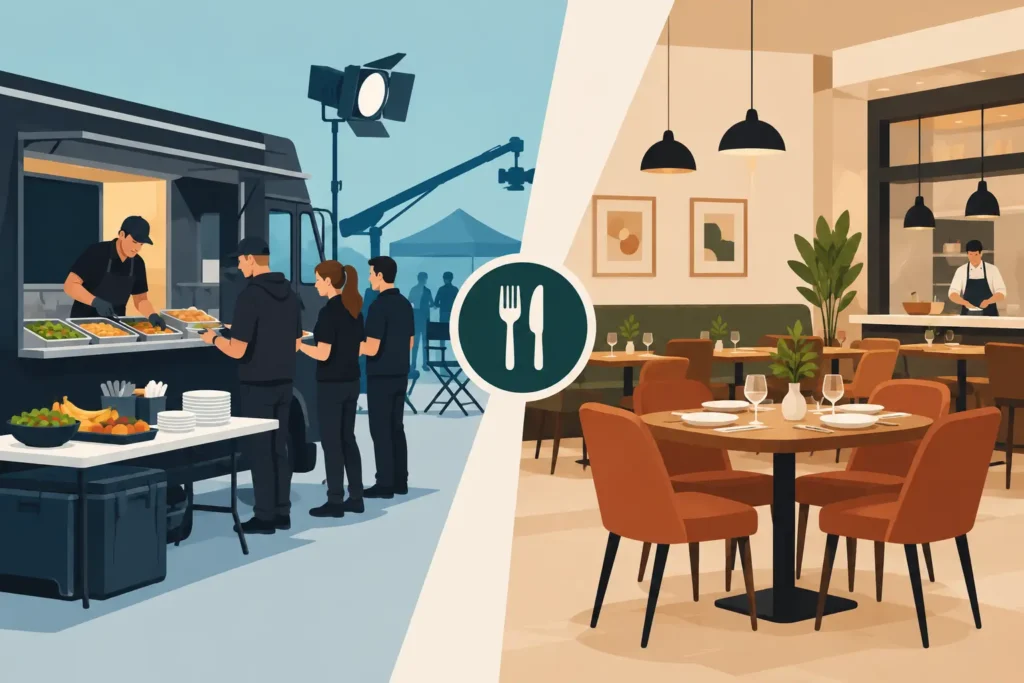
A runner sent to collect restaurant orders may seem like the easy option at 8am. By midday, when the order is late, half the team has different dietary needs and the next setup is waiting, it can become a production problem. Crew catering versus restaurants is not simply a question of where the food tastes best. It is about protecting the schedule, keeping people properly fed and giving cast, crew and clients confidence that service will not hold up the day.
Restaurants have their place, especially for a small office meeting or a relaxed post-wrap dinner. But film sets, TV studios, backstage areas and fast-moving events run to a different rhythm. The best choice depends on crew numbers, access, call times, budget, location and how much flexibility the day demands.
Crew Catering Versus Restaurants: The Real Difference
A restaurant is designed around its own service model. It has set opening times, a fixed kitchen, a dining area, a menu that may change without notice and other customers to serve. Even a good delivery order can be affected by traffic, driver availability, peak trading periods or a kitchen that is already under pressure.
Crew catering is planned around the production. Meals can arrive for an early unit call, be served in staggered waves around filming, or be held safely in hot boxes when a break moves. Food comes to the studio, location, green room, loading bay, backstage corridor or temporary unit base, rather than asking a working team to leave site and hope they return on time.
That distinction matters most when the day has no room for drift. A 20-minute delayed lunch does not stay a 20-minute delay if departments are spread across a location, talent needs a separate service window, and the afternoon schedule depends on everyone being ready to go again.
Timing Is a Crew-Welfare Issue
On a production, food is part of the working day. A proper meal break helps people reset, concentrate and maintain energy through long calls, physical work and demanding conditions. It also demonstrates that the people making the job happen are being looked after.
Restaurant food can work for a modest group with a predictable break, particularly when there is a trusted local supplier close to the venue. The risk rises when every individual order is placed separately. Choices have to be collected, payments reconciled, food checked, missing items chased and packaging distributed. What looked flexible can create work for an already busy production office.
A dedicated crew caterer plans service around the actual timetable. That could mean breakfast ready before a dawn call, fresh hot lunch at a precise time, afternoon snacks for a late push, or substantial evening food for a night shoot. If the schedule changes, the catering team is already part of the operational conversation, rather than a restaurant discovering the request once the food has left its kitchen.
Staggered Service Keeps Departments Moving
Not every team can break at once. Camera may need to cover a reset, security may remain on post, artists may require privacy and a live event crew may be working through doors. Catering can be structured in waves, with portions replenished and hot food managed safely across a wider service period.
Restaurants generally serve food when it is ordered or delivered. Production catering can organise service so the food works around the crew, not the other way round. That difference is often what keeps a tight day calm.
Food Quality Is Not the Trade-Off
Choosing crew catering does not mean accepting functional, repetitive food. The strongest production menus bring restaurant-quality cooking to the location while also recognising what people need to eat during a long shift: generous portions, clear labelling, variety and food that travels and holds well.
Creative, flavoursome dishes from around the globe can sit alongside familiar crew favourites. Think vibrant curries, slow-cooked mains, fresh salads, filling plant-based dishes, sandwiches made for grab-and-go moments, and comforting hot puddings when the weather turns. The right menu feels considered without becoming impractical to serve from a mobile kitchen, unit base or backstage station.
Restaurants may offer excellent individual dishes, but they are not always built for volume or service consistency. A menu that shines plated in-house can arrive less successfully after a journey across London. For a crew of 80 or 200, it is worth asking whether the food has been designed to remain fresh, hot, presentable and easy to serve at the required time.
Dietary Requirements Need One Clear Plan
Dietary provision is where restaurant ordering can become especially fragile. One meal may be vegan, another gluten-free, another nut-free, while an allergy requires strict separation and a fully informed handover. Multiple restaurant orders mean multiple kitchens, delivery drivers, labels and points of failure.
A crew caterer can build dietary needs into the menu from the outset. Separate options can be prepared, labelled and positioned clearly, with allergen information available to the team. This is not only about avoiding last-minute substitutions. It allows everyone to eat a meal that feels equally generous, rather than receiving an afterthought.
There are limits, of course. Severe allergies and medically necessary diets require early, specific information from the client so that the caterer can assess safe preparation, storage and service procedures. Good planning is a shared responsibility, but one coordinated catering partner makes it far easier to manage.
Cost Is More Than the Menu Price
Restaurant meals can look cheaper on a per-head basis, especially when comparing a single dish against a full catering quote. That comparison often misses the operational costs: delivery fees, service charges, individual-order admin, cutlery, drinks, staff time, late changes and the cost of lost minutes when food does not land as planned.
Crew catering can include far more than the food itself. Depending on the brief, that may cover menu planning, hot holding equipment, service staff, mobile kitchen provision, waste-conscious packaging, setup, clearing and coordination with the location or production team. A tailored package makes it easier to see what is being handled and where the budget is going.
For a very small team, a nearby restaurant may still be the sensible choice. For a larger crew, a remote location, a multi-day shoot or any schedule with moving parts, catering usually provides stronger control over both spend and outcomes. The question is not just, “What does lunch cost?” It is, “What will it cost if lunch disrupts the day?”
Location Changes the Decision
Central London offers plenty of restaurant choice, but access can still be difficult. Parking restrictions, congested streets, limited loading windows and large sites can turn a short delivery route into a logistical gamble. Outside the city, the challenge may be the opposite: there may be nowhere nearby that can feed a full unit at all.
Production catering is built to work in less-than-perfect conditions. Whether the job is in a studio, a private venue, a field location, a stadium or a temporary backstage compound, the service can be planned around power, access, weather, welfare facilities and available space. Health and safety is considered as part of the setup, not left to chance after the food arrives.
D’Lights Event Catering works this way because a production meal needs more than good cooking. It needs confident coordination from the first call through to the final service.
When Restaurants Are Still the Right Call
Restaurants are a strong option for client dinners, wrap celebrations, intimate meetings and small groups with time to sit down. They can also be useful when the venue is next door, the headcount is low and everyone can eat at the same time without affecting the schedule.
The key is to use them for what they do best: hospitality in a fixed setting. If the job requires food to arrive at a precise call time, feed a mixed crew quickly, handle extensive dietary needs or move with the production, specialist catering is the safer fit.
Before booking, give the catering team the real picture: headcount, call sheet, service windows, venue access, dietary requirements, budget, whether meals need to travel and what happens if the day runs late. With that information early, food becomes one less variable for the production team to manage. Request a menu and book the service that keeps your crew focused, fed and ready for the next take.