
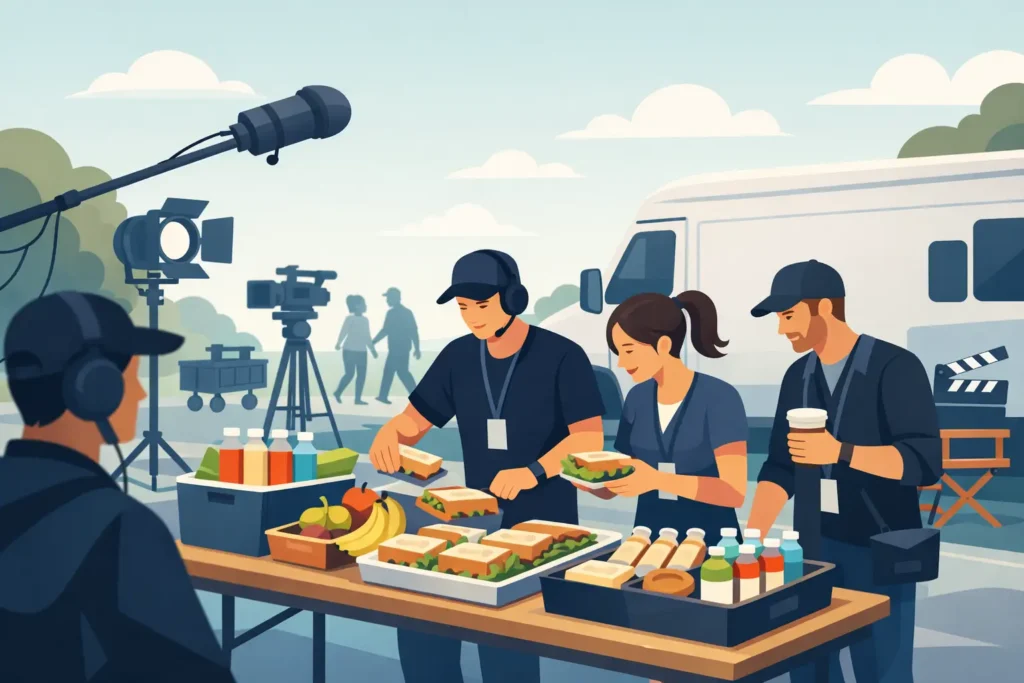
A missed meal break can throw more than morale off balance. When a unit is turning around a location, resetting lights or pushing towards the final take before losing daylight, nobody has time to queue for lunch or chase a dietary option that has been put aside somewhere else. Grab and go crew catering gives people properly prepared food they can collect quickly, take to their work area and eat when their department gets a window.
For productions, backstage teams and fast-paced events across London, the point is not simply to put sandwiches on a table. It is to keep cast, crew and guests fed, hydrated and looked after without interrupting the schedule. Done well, grab-and-go service becomes part of the day’s operational plan: clearly labelled, generously stocked, ready at the right call time and replenished around the rhythm of the job.
Why grab and go crew catering earns its place on set
A hot sit-down meal is still the right choice for many production days, particularly when the schedule allows for a full break and the crew needs a proper reset. But not every call sheet works that way. Split crews, overnight filming, constrained locations, short turnaround times and staggered breaks all create moments when portable food is the more useful option.
Grab-and-go catering gives each department flexibility. Camera teams may need something substantial between setups. Runners may be moving continuously. Artists, drivers and security teams may break at entirely different times. A well-planned station means no one is left relying on vending machines, cold leftovers or a last-minute shop run.
It also protects the production from a familiar problem: the catering table that looks full at the start of service but is picked over by the time later shifts arrive. Quantities, replenishment and placement need to reflect who is actually on site, when they are working and whether they can leave their post. This is where production-aware planning matters as much as the menu itself.
Food that travels well and still feels like a meal
The strongest grab-and-go menus are built for real working conditions. Food may be carried through a studio corridor, eaten in a green room, taken into a production office or picked up between sound checks. It needs to hold its quality, be easy to open and give people enough energy to get through the next stretch of the day.
That does not mean every item has to be beige, bland or wrapped in plastic. Freshly prepared wraps, filled focaccia, colourful grain bowls, salad pots, protein boxes and warming hot boxes can all work beautifully when chosen for the environment. Creative and flavoursome dishes from around the globe bring variety to long production days, while familiar favourites make sure there is always something comforting and dependable.
Balance is key. A station made up entirely of sweet snacks will create a quick lift and a familiar mid-afternoon slump. Equally, heavy meals can be awkward before physically demanding work or during a compressed schedule. Combining substantial savoury choices with fruit, yoghurt, baked treats and drinks gives crew members a genuine choice without making the setup complicated.
For colder exterior shoots, portable hot options can make a significant difference. Soup in secure containers, hot breakfast rolls, rice or noodle boxes, and individually packed warm meals offer comfort when people are working in rain, wind or low temperatures. In summer, chilled salads, fruit pots and refreshing drinks need particular attention, including safe holding temperatures and sensible replenishment.
Build the menu around the call sheet
The menu should follow the day rather than a generic package. An early call may need breakfast items that can be eaten one-handed: pastries, fruit, overnight oats, breakfast baps and good coffee. A noon-heavy schedule calls for filling lunch choices, while a night shoot needs food that is satisfying without feeling like a second dinner at 2 am.
Ask practical questions before confirming the menu. What is the first call time? When are the expected rushes? Is there a company move? Are there separate unit bases, green rooms or backstage areas? Will any teams be working away from the main catering point? The answers determine delivery time, service layout, portion numbers and whether additional drops are wiser than one large delivery.
Dietary requirements cannot be an afterthought
Crew welfare is not achieved by placing one vegan item at the end of a table and hoping it remains available. Dietary requirements must be counted, planned and labelled from the outset. That includes vegetarian, vegan, halal, gluten-free and dairy-free needs, as well as declared allergies and specific individual requests.
Clear labels allow people to make quick, confident choices. Separate presentation and sensible handling reduce confusion, particularly where allergens are involved. The catering team also needs a reliable process for confirming requirements before the service day, because a last-minute change can be manageable only if it is communicated.
There is a trade-off here. The bigger the menu range, the more choice crews enjoy, but the more tightly stock, labelling and food safety need to be managed. On a smaller shoot, a focused menu with excellent alternatives often performs better than an oversized spread with too much waste. On a major production, multiple clearly defined selections and timed restocking may be essential.
Service layout matters as much as the food
A grab-and-go station should be obvious, accessible and quick to use. If it is hidden behind the production office, blocked by equipment or too close to a busy entrance, people will miss it or create a bottleneck. At the same time, it must not interfere with cables, fire routes, talent access or the working flow of the location.
For larger crews, separate points can keep service moving: one for savoury items, one for drinks and snacks, and a dedicated area for dietary meals where appropriate. At compact locations, the answer may be a carefully packed delivery that production can put out in stages. There is no single setup that suits every shoot.
Packaging deserves the same attention. It should be practical to carry, secure enough to prevent spills and appropriate for the food inside. Waste-conscious packaging is a worthwhile priority, but it has to work under the conditions. A delicate compostable box is not much use if it collapses on a wet location floor. Good catering decisions account for sustainability, hygiene and the reality of a moving crew.
Timing, replenishment and communication keep it reliable
The phrase “ready for lunch” means different things to different teams. For a caterer, it should mean food is delivered, presented, labelled and available before the first person needs it. A delivery that arrives at the official break time may already be late if production staff need to set up the area or the crew is breaking in waves.
Reliable grab-and-go crew catering starts with a confirmed schedule and stays flexible enough to respond when the day changes. Filming runs over. Access windows move. A location manager calls with a revised entrance point. Rain changes the working area. These are normal production pressures, not exceptional ones, and the catering plan should allow for them.
Replenishment is often what separates an adequate service from a genuinely supportive one. Fresh items should not sit out longer than they should, and later breaks deserve the same consideration as the first. For longer days, planned top-ups keep the offering attractive and safe while preventing over-ordering at the start.
D’Lights Event Catering plans around call times, crew movements, menu requirements and the practical limits of each venue or location. That can mean a fully staffed station, hot boxes delivered to the right point, mobile kitchen support or a tailored drop-off service that gives the production team one less job to manage.
A better brief produces better crew food
When requesting a catering proposal, provide the crew count, location, dates, service times, budget range and any known dietary requirements. Include the style of production and whether the team needs breakfast, lunch, late-night food, continuous snacks or all of the above. It is also useful to flag access restrictions, parking arrangements, lift access, power availability and whether catering must be quiet, discreet or positioned out of public view.
The more accurate the brief, the more confidently a catering team can advise on quantities and format. A 30-person commercial shoot with staggered calls needs a different solution from a 200-person concert crew working backstage, even if both ask for lunch bags. The food, delivery pattern and staffing should reflect the job rather than a one-size-fits-all package.
Crew members notice when food arrives on time, tastes fresh and includes them rather than treating their requirements as an inconvenience. Give the catering plan the same practical care as transport, power and scheduling, and it will quietly keep the whole day moving. Request a menu early, confirm the changing details quickly and make every break count.